Artisan or Industrial? Why Bakery Automation Does Not Have to Mean Choosing One Over the Other
Artisan or Industrial? Why Bakery Automation Does Not Have to Be an Either-Or Choice
For decades, the bakery industry has often been described through a simple distinction:
Artisan or industrial.
Artisan baking is associated with carefully selected ingredients, distinctive recipes, skilled bakers and products developed with particular attention to flavour, texture and character.
Industrial production, on the other hand, is often associated with automation, standardisation, high volumes and efficiency.
But does a bakery really have to choose between the two?
In reality, a bakery can be highly deliberate about its ingredients, invest heavily in recipe development and consumer research, and build a distinctive product — while also using automation to produce that product consistently at a larger scale.
The two approaches are not necessarily opposites.
The more useful question is:
What makes the product unique, and which parts of production can be automated without changing what makes it unique?
Artisan Is More Than Making Products by Hand
When people think of artisan baking, they often think of manual production.
But the value of an artisan product does not necessarily come from every step being performed by hand.
We have seen this through our own customers at Lian Huat.
Some customers have extremely specific requirements for the ingredients used in their products. For example, one customer developed bread recipes that contain no water at all, using milk as the sole liquid ingredient. That decision is not simply a production preference. It is part of the product's identity and the experience the bakery wants to create.
Other customers have invested significant time and resources in recipe development and product testing. Some have organised competitions, invited members of the public to taste different products, collected feedback and even purchased recipes that received the strongest response.
Others have invested in market research to understand which flavours and products are most likely to be accepted by consumers.
These are all examples of what makes an artisan approach valuable.
They demonstrate that artisan baking is not simply about whether a product is made by hand.
It is about the decisions, knowledge, experimentation and attention that go into creating the product in the first place.
And these efforts have little to do with whether the subsequent production is manual or automated.
Automation Does Not Have to Replace Artisan Production
This is where the traditional distinction between artisan and industrial becomes less useful.
Automation does not necessarily mean replacing every manual process or turning a distinctive bakery product into a standardised commodity.
Instead, automation can be applied to the parts of production that are highly repetitive, labour-intensive or difficult to maintain consistently as volumes increase.
Industry discussions in 2026 increasingly reflect this approach. Recent coverage of artisan bread production highlights the need to automate carefully — focusing on labour-intensive tasks while protecting the processes and characteristics that define artisan quality.
This leads to a simple principle:
Automate the repetitive parts of production, not the decisions that define the product.
A bakery may already know exactly what its product should taste like, how it should look and what characteristics it should have.
Automation can then help reproduce the required production process more consistently.
Where Can Automation Add Value?
Not every bakery needs to automate every stage of production.
A more practical approach is to identify processes that are:
Highly repetitive
Labour-intensive
Physically demanding
Sensitive to operator variation
Becoming bottlenecks as production increases
For example, once a bakery has established its target dough weight and product characteristics, repeatedly dividing and rounding large quantities of dough becomes a repetitive production task.
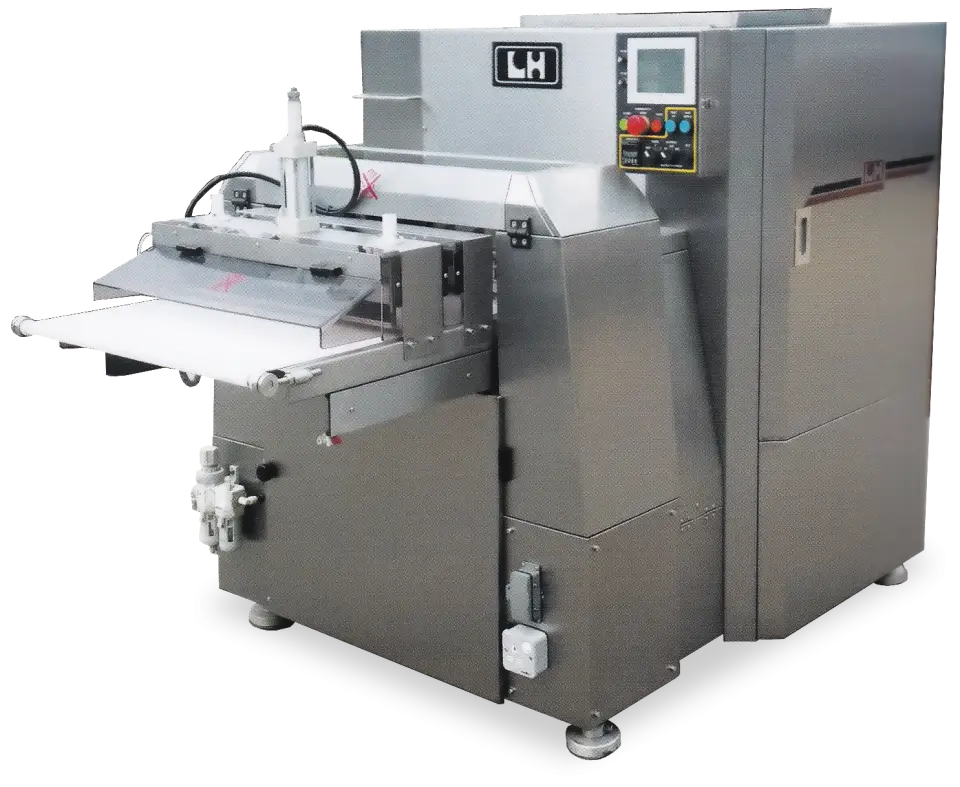
Dough Divider Rounder Make Up
Designed for commercial bakeries, central kitchens, and food manufacturers, the Lian Huat Dough Divider Rounder automates dough dividing and rounding to improve production efficiency and consistency. Available in multiple configurations and production capacities to suit different production requirements. It provides consistent dough portioning and uniform rounding for reliable downstream processing.
Built with industrial-grade construction and engineered for continuous production, the machine helps reduce dependence on manual labour while maintaining consistent dough handling and production output. Its automated dividing and rounding process supports more efficient bakery operations, improved product uniformity, and reliable performance in high-volume production environments.
A Dough Divider Rounder can automate this part of the process, producing dough portions and rounded pieces according to the selected configuration.
The bakery's recipe has not changed.
Its ingredients have not changed.
Its product identity has not changed.
What has changed is the way the repetitive part of production is carried out.
From Dough Handling to Automated Panning
The same principle can be extended to the next stage of production.
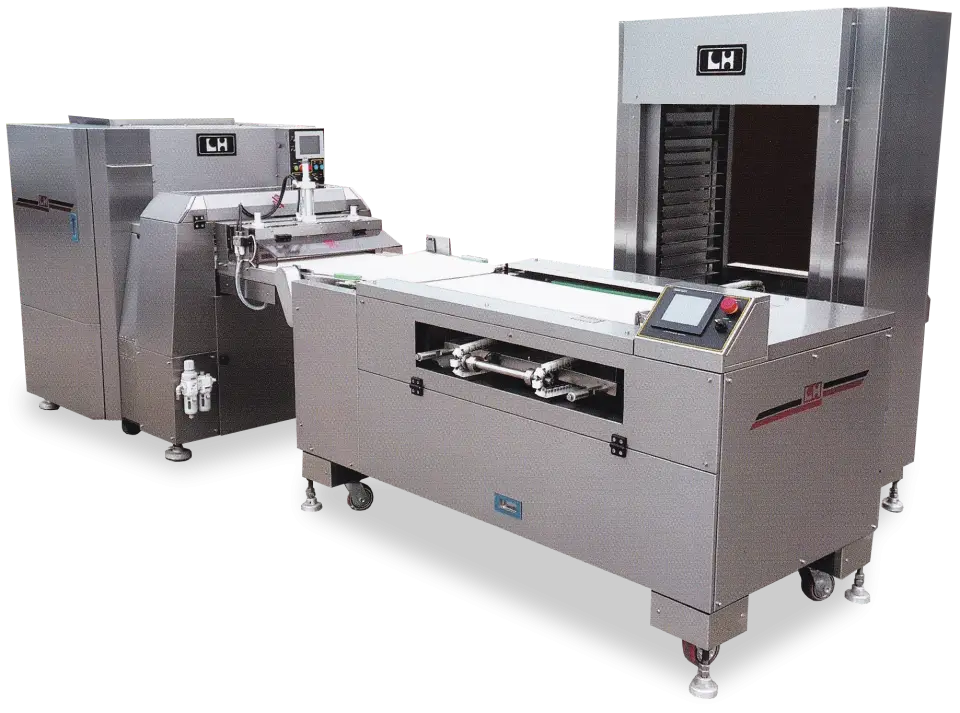
Dough Divider Rounder with Auto Panning System Make Up
The Dough Divider Rounder with Auto Panning System combines dough dividing and rounding with an optional automated panning system for arranging processed dough pieces onto baking trays.
The Auto Panning System can be assessed for use with a dough divider rounder or other suitable upstream equipment, including encrusting machines. Its configuration depends on the product weight, dough formulation, tray type and upstream machine requirements.
A Dough Divider Rounder with Auto Panning System can combine dividing and rounding with automated transfer and tray placement.
Instead of operators repeatedly handling and arranging individual dough pieces, these steps can be integrated into a more continuous production flow.
This can become particularly valuable when manual handling starts to limit production capacity.
The objective is not to make the product more industrial.
It is to make the production process more consistent, manageable and scalable.
Scaling Without Losing Product Identity
This becomes especially important when a successful bakery product begins to grow.
Imagine a bakery that has spent years developing a signature bun.
It has refined the recipe, selected specific ingredients, tested different flavours, studied consumer preferences and established the desired weight, shape and texture.
The product becomes successful.
Demand increases.
Production needs to grow from hundreds of pieces a day to thousands.
The challenge is no longer simply:
“Can we make this product?”
It becomes:
“Can we continue making this product consistently as production grows?”
This is where automation can support the bakery.
The machine does not decide what makes the product special.
The bakery does.
The role of the equipment is to help reproduce the required production steps with greater consistency and efficiency.
Recent industry coverage has similarly identified product consistency and repeatability as important benefits of bakery automation, alongside labour and throughput considerations.
Automation Should Support the Product, Not Define It
This does not mean every bakery should pursue full automation.
Different products, production volumes and business models require different levels of automation.
A bakery producing highly specialised or seasonal products may still require significant manual involvement.
Another bakery producing thousands of buns every day may benefit from automating more of its dough handling and production processes.
The goal should therefore not be:
“Automate everything.”
It should be:
“Automate where automation creates meaningful value.”
That may mean starting with dough dividing and rounding.
It may mean adding automated panning.
For larger operations, it may mean connecting multiple stages into a more continuous production flow.
In other words, automation does not have to be an all-or-nothing decision. Recent industry discussions also highlight modular and gradual automation as practical approaches for bakeries that need to grow while maintaining flexibility.
Artisan Thinking Can Scale
A bakery can remain highly deliberate about:
Ingredients.
Recipes.
Flavour.
Product development.
Consumer preferences.
Quality standards.
At the same time, it can use automation for:
Dough handling.
Dividing.
Rounding.
Panning.
Moulding.
Material handling.
The two approaches are not mutually exclusive.
A bakery can continue to be highly intentional about what it produces, while using automation to improve how consistently and efficiently it produces it.
That may be a more realistic way to think about the future of bakery production.
Where Could Your Bakery Automate Next?
If your bakery already has a successful product, the next step does not necessarily have to be a fully automated production line.
Start by asking:
Which production task consumes the most repetitive labour?
Where does operator variation affect product consistency?
Which process is becoming a bottleneck as production increases?
Which part of the workflow could be automated without changing the product itself?
These questions can help identify where automation can create the most practical value.
At Lian Huat, we work with bakery businesses to identify suitable automation opportunities across dough handling, dividing, rounding, panning and other production processes.
The right automation solution should not change what makes your product different.
It should help you produce more of it — more consistently, more efficiently and at the scale your business requires.
References
-
[1]
Automating artisan bread processing without sacrificing craftAvailable at: bakingbusiness.com
-
[2]
Automation adds consistency to artisan bakingAvailable at: bakingbusiness.com
Recent Posts
See All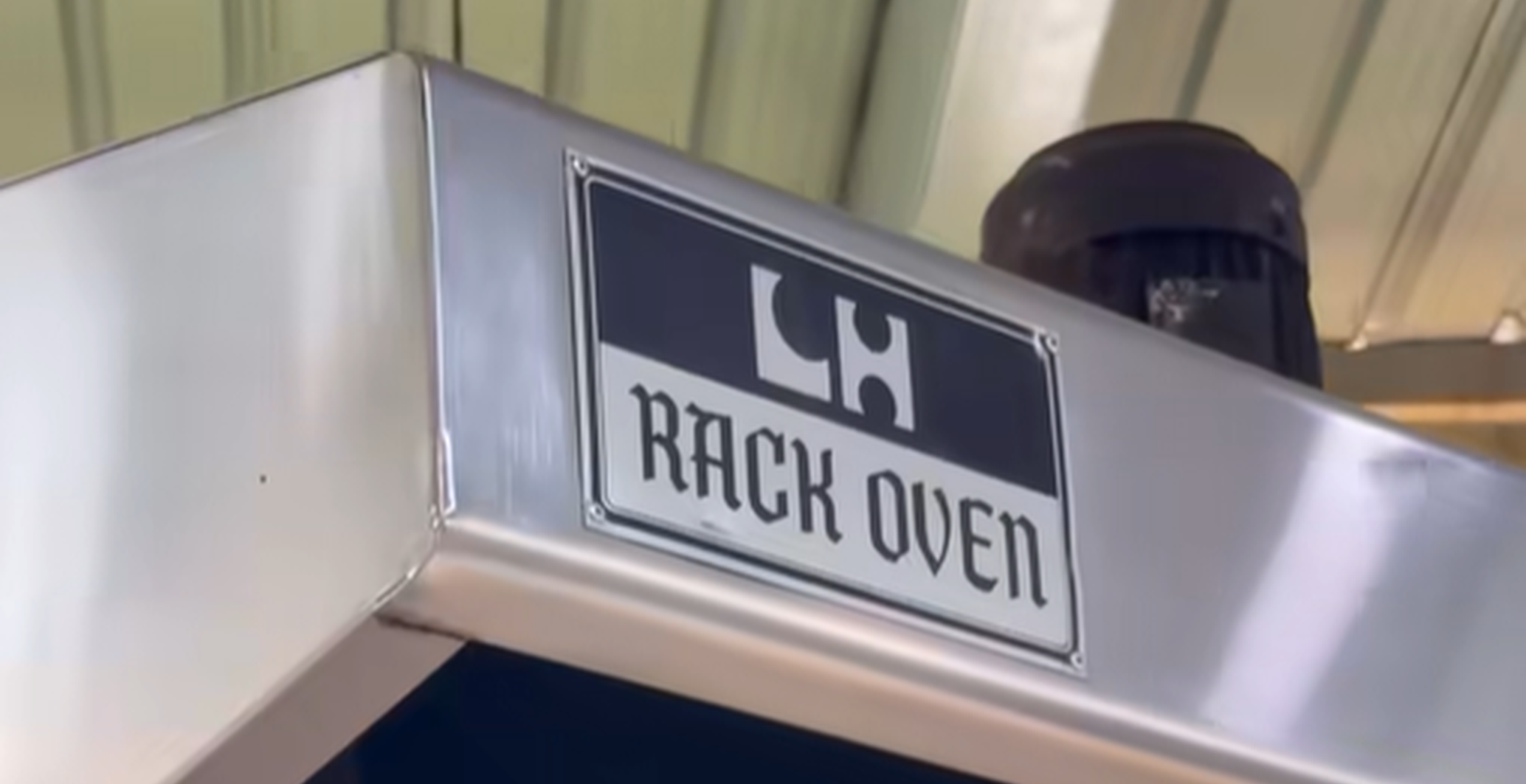
Henrick Low •
Oct 19, 2026 •
2 minutes read
Growing Across Generations: Tian Hup Seng's Bakery Journey with Lian Huat
Tian Hup Seng, established in 1977, purchased three Lian Huat Rack Ovens between 1992 and 2011. Discover the bakery's long-standing customer story.
Read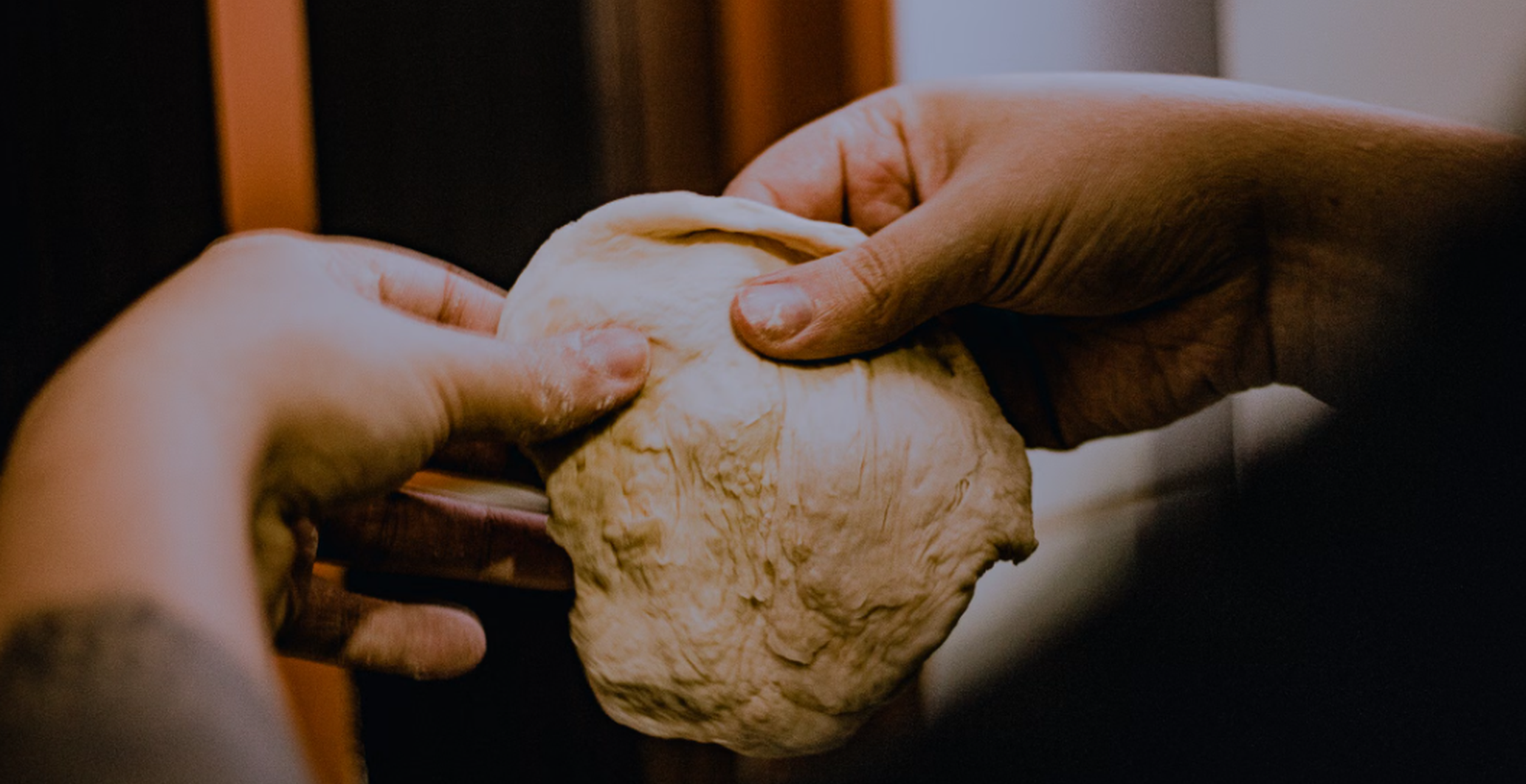
Henrick Low •
Oct 7, 2026 •
8 minutes read
Beyond Dough Hydration: How International Bakery Projects Shape Our Engineering Evaluation
How international bakery projects and servicing experience shape Lian Huat’s approach to evaluating dough characteristics and machinery requirements.
Read
Henrick Low •
Sep 30, 2026 •
5 minutes read
Case Study: Designing a T-Shaped Intermediate Proofer for a Space-Constrained Bakery in Sri Lanka
A customized T-shaped intermediate proofer developed for a Sri Lankan bakery to automate proofing within limited installation space.
Read