
Case Study: Designing a T-Shaped Intermediate Proofer for a Space-Constrained Bakery in Sri Lanka
Customer Challenge: Automating Intermediate Proofing Within Limited Space
A bakery in Sri Lanka produces round-shaped bread and required a more controlled and automated intermediate proofing process.
The customer needed the dough pieces to remain in the intermediate proofer for a defined period before continuing to the next stage of production. This meant that the intermediate proofing process needed to be integrated into the production line rather than relying on manual handling.
However, the available installation space presented an important engineering constraint.
A conventional intermediate proofer configuration requires a larger footprint and a specific machine arrangement. For this project, simply supplying Lian Huat's standard configuration would not fully match the customer's available space and production requirements.
The challenge was therefore not only to provide an intermediate proofer, but to adapt the machine configuration around the customer's actual production environment.
Understanding the Customer's Requirements
Before developing the configuration, several practical requirements had to be considered:
- The dough required a controlled intermediate proofing process
- The intermediate proofing process needed to be integrated into the production line
- Available installation space was limited
- The customer had a specific requirement for the dough's proofing time
The space limitation was particularly important because the machine could not simply be installed according to the footprint of a conventional intermediate proofer.
Therefore, Lian Huat needed to consider how to achieve the required proofing time within the available installation space.
Lian Huat's Engineering Approach
The key engineering consideration was the relationship between proofing time, conveyor length and available floor space.
An intermediate proofer requires sufficient travelling distance for the dough to remain inside the proofing chamber for the required period. Normally, providing a longer travelling distance would also require a larger machine footprint.
For this project, Lian Huat developed a different configuration.
Instead of maintaining the conventional layout, the conveyor system was arranged into multiple passes within the machine. This allowed the required travelling distance to be accommodated within the customer's limited installation area.
The result was a T-shaped intermediate proofer, specially developed for this application.
This approach allowed Lian Huat to retain the intended intermediate proofing process while adapting the overall machine configuration to the customer's physical constraints.
Standard Configuration vs. Customized Configuration
Lian Huat's standard intermediate proofer uses a conventional multi-level conveyor arrangement to provide the required travelling distance within the proofing chamber.
Standard Configuration
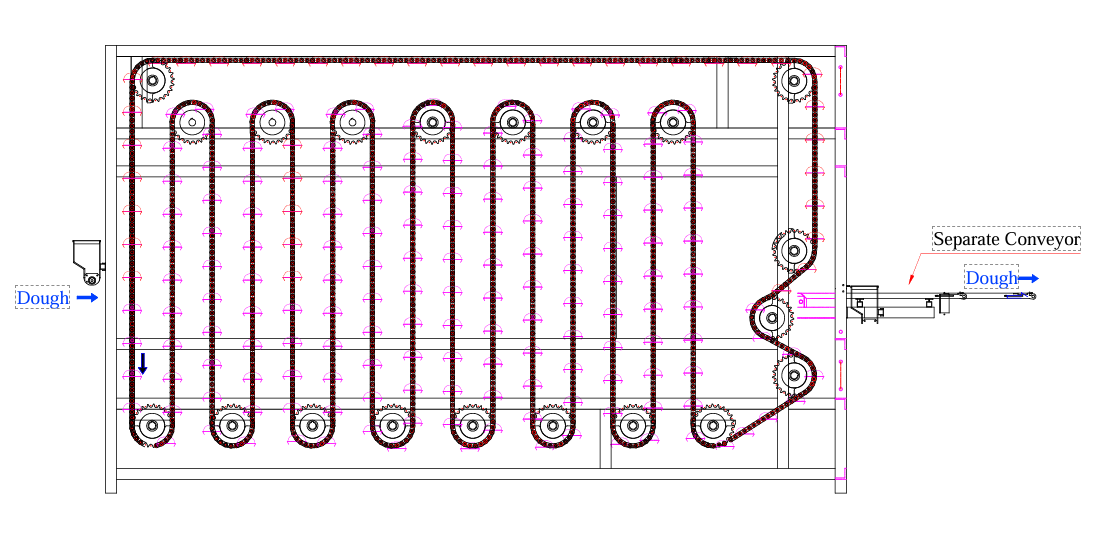
Lian Huat's standard intermediate proofer configuration.
For this Sri Lankan project, the basic intermediate proofing concept remained unchanged. The main difference was the arrangement of the machine and conveyor system.
Customized T-Shaped Configuration
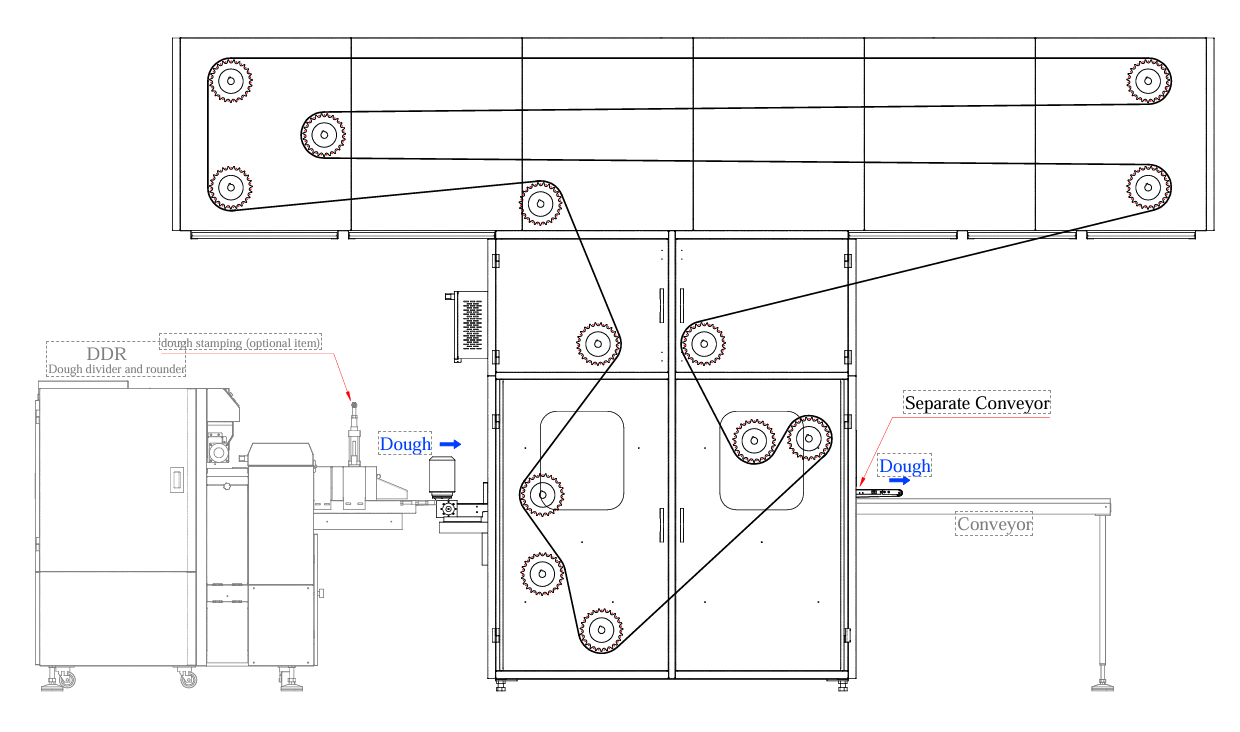
A customer-specific configuration developed to make better use of the available installation space.
| Standard Configuration | Customized Configuration | |
|---|---|---|
| Machine layout | Standard layout | T-shaped layout |
| Conveyor system | Standard configuration | Reconfigured according to available space |
| Installation consideration | Standard footprint | Adapted to limited space |
| Application | General production layout | Space-constrained production environment |
The customization was therefore not simply a change in machine dimensions. The internal arrangement was reconsidered to make the intermediate proofer suitable for the customer's specific installation conditions.
Engineering Considerations
Several practical engineering factors were considered during the development of the customized configuration.
Conveyor Length
The conveyor system needed to provide sufficient travelling distance to achieve the customer's required proofing time.
By arranging the conveyor into multiple passes, Lian Huat was able to make better use of the available machine space without simply extending the machine footprint.
Machine Layout
The overall machine arrangement was redesigned around the customer's available installation area.
The resulting T-shaped configuration provides a different footprint from the standard intermediate proofer while retaining the intended function of the equipment.
Production Line Integration
The intermediate proofer needed to form part of the customer's existing production line. Its configuration therefore had to be considered together with the surrounding equipment and available installation area.
These considerations demonstrate that machinery customization can involve machine layout and internal configuration, rather than only changing dimensions or production capacity.
Result: Intermediate Proofing Within a Space-Constrained Production Line
The completed design provides the Sri Lankan bakery with a customer-specific T-shaped intermediate proofer developed around its available installation space and required proofing time.
The project demonstrates how a standard bakery machine concept can be adapted when the customer's factory layout does not allow a conventional configuration.
Rather than changing the purpose of the intermediate proofer, Lian Huat retained the required proofing process while modifying the machine layout and conveyor arrangement to suit the application.
This allowed the equipment to be integrated into the customer's production environment without treating the standard machine configuration as the only possible solution.
Key Takeaway
Bakery automation does not always mean installing standard machines in a standard layout.
In real production environments, factors such as available space, required proofing time, machine footprint and production line integration can influence the final machine design.
For this Sri Lankan project, Lian Huat developed a T-shaped intermediate proofer to address the customer's limited installation space while maintaining the required intermediate proofing process.
The project reflects a straightforward engineering principle:
The right machine configuration should be developed around the customer's actual production environment—not simply around a standard machine layout.
Recent Posts
See All
Henrick Low •
Oct 7, 2026 •
8 minutes read
Beyond Dough Hydration: How International Bakery Projects Shape Our Engineering Evaluation
How international bakery projects and servicing experience shape Lian Huat’s approach to evaluating dough characteristics and machinery requirements.
Read
Henrick Low •
Sep 29, 2026 •
5 minutes read
Case Study: Customizing Bakery Machinery for Easier Operation and Flexible Servicing in Taiwan
A Taiwan case study on customizing a machine's control system around the customer's operational and servicing requirements.
Read
Henrick Low •
Sep 15, 2026 •
7 minutes read
Artisan or Industrial? Why Bakery Automation Does Not Have to Mean Choosing One Over the Other
Artisan and industrial baking are not opposites. Discover how bakery automation can improve consistency, efficiency, and scalability while preserving the product identity that makes a bakery unique.
Read