
Beyond Labor Shortages: Building Stable and Scalable Food Production in Southeast Asia
Beyond Labor Shortages: Building Stable and Scalable Food Production in Southeast Asia
Labor availability has always been an important consideration for food manufacturers. But across Southeast Asia, the conversation is gradually changing.
The question is no longer simply whether a factory can find enough workers.
It is whether the factory can maintain stable production when labor availability, production volume, and business requirements continue to change.
This distinction is important.
A production process that depends heavily on repetitive manual labor can become difficult to scale even when workers are available. Increasing output often means adding more people. Higher demand requires additional shifts. Staff turnover requires continuous recruitment and training. Physical and repetitive work can make it increasingly difficult to maintain the same productivity throughout a shift.
In other words, labor shortage is only one symptom. The deeper challenge is building a production system that remains stable despite changes in labor availability.
For food manufacturers in Southeast Asia, this is becoming increasingly relevant as the region's manufacturing sector continues to move toward higher productivity and greater technological integration.
Southeast Asia Is Moving Toward More Productive Manufacturing
Southeast Asia remains an important manufacturing base, supported by investment, regional supply chains, and growing domestic demand.
The ASEAN Secretariat reported in 2025 that manufacturing accounted for 20% of ASEAN's total foreign direct investment inflows in 2024, up from 9% in 2023. The organization also highlighted a broader transition toward more technology-intensive manufacturing, with companies increasingly incorporating automation, robotics, and digital technologies to improve efficiency and competitiveness.
The region's economic outlook remains closely connected to manufacturing and investment. The Asian Development Bank's July 2026 outlook projects 4.6% growth for developing Southeast Asia in 2026, with manufacturing, exports, investment, and domestic demand continuing to support the region's economies.
At the same time, the workforce itself is changing.
The OECD and ERIA reported in 2025 that ageing is expected to accelerate across Southeast Asia. The old-age-to-working-age ratio across ASEAN is projected to increase by 19 percentage points over the next 30 years, with the ratio expected to at least double in every ASEAN country.
ASEAN labour ministers have also identified rapid technological change, demographic shifts, evolving labour markets, and labour mobility as factors reshaping workforce requirements across the region.
These changes do not mean that Southeast Asia will simply "run out of workers."
The more important implication is that manufacturers cannot assume that increasing production will always be achieved by increasing the number of people performing manual work.
Productivity has to become part of the equation.
The Real Problem: Too Much Dependence on Manual Work
Consider a simple bakery production process.
A worker repeatedly handles dough, portions it, rounds it, transfers it, and prepares it for the next stage.
One worker can produce a certain amount.
If demand increases, more workers are added.
If the factory operates another shift, more workers are required.
If absenteeism increases, production capacity falls.
If turnover increases, management must spend more time recruiting and training.
None of these problems necessarily comes from a lack of technical knowledge.
They come from the structure of the process itself.
The production system requires people to repeatedly perform the same physical tasks in order to maintain output.
This is where automation creates value.
The objective is not simply to replace a person.
It is to change the production process so that the same level of output no longer requires the same amount of repetitive manual intervention.
That distinction is particularly important in food manufacturing, where many processes involve continuous handling, portioning, transferring, forming, and arranging.
The World Bank's research on technology and jobs in East Asia and the Pacific provides useful evidence of this broader relationship. In Indonesia, Malaysia, the Philippines, Thailand, and Viet Nam, industrial robot adoption between 2018 and 2022 was associated with the creation of approximately 2 million jobs for skilled formal workers while displacing around 1.4 million lower-skilled formal workers performing routine and manual tasks. The World Bank attributes part of the employment increase to productivity and scale effects generated by automation.
The lesson for food manufacturers is not that machines automatically replace workers.
It is that automation changes the economics and structure of production.
When repetitive tasks become more automated, people can spend more time supervising production, handling exceptions, maintaining equipment, managing quality, and supporting higher-value activities.
Automation Should Stabilize Production Before It Expands Production
When manufacturers think about automation, capacity is often the first consideration.
How many pieces can the machine produce?
How many workers can be reduced?
How quickly can the investment pay back?
These questions are important, but they are incomplete.
The first question should be:
Which part of the production process is creating the greatest dependence on repetitive manual work?
The second should be:
Can automating that process make the entire production flow more stable?
This is where a progressive approach to automation becomes valuable.
Instead of attempting to automate an entire factory immediately, manufacturers can begin with a process that has a strong influence on consistency, labor requirements, and downstream production.
Once that process is stable, additional automation can be introduced around it.
The result is not a single large automation project.
It is a production system that develops progressively.
Finding the Right Starting Point for Bakery Automation
There is no universal starting point for automation.
The right starting point depends on the product, the production process, the amount of manual work involved, and how one process affects the next.
For bakery manufacturers, this requires looking at the production flow as a connected system rather than evaluating each machine independently.
Before a dough piece can be formed, panned, baked, or packaged, it must first move through a series of controlled processes.
That makes the upstream handling of dough particularly important.
If dough enters the next stage with inconsistent portions, shapes, or production rhythm, downstream processes have to compensate.
If the dough process is stable, the subsequent stages have a more predictable starting condition.
This creates a natural production sequence:
Dough Handling → Dividing → Rounding → Forming → Downstream Automation
The objective is not to automate every stage immediately.
It is to identify the stage where automation can create the greatest improvement in overall production stability.
For many bakery operations, dough dividing and rounding can be an effective starting point because they sit at an important point between dough preparation and subsequent forming or handling processes.
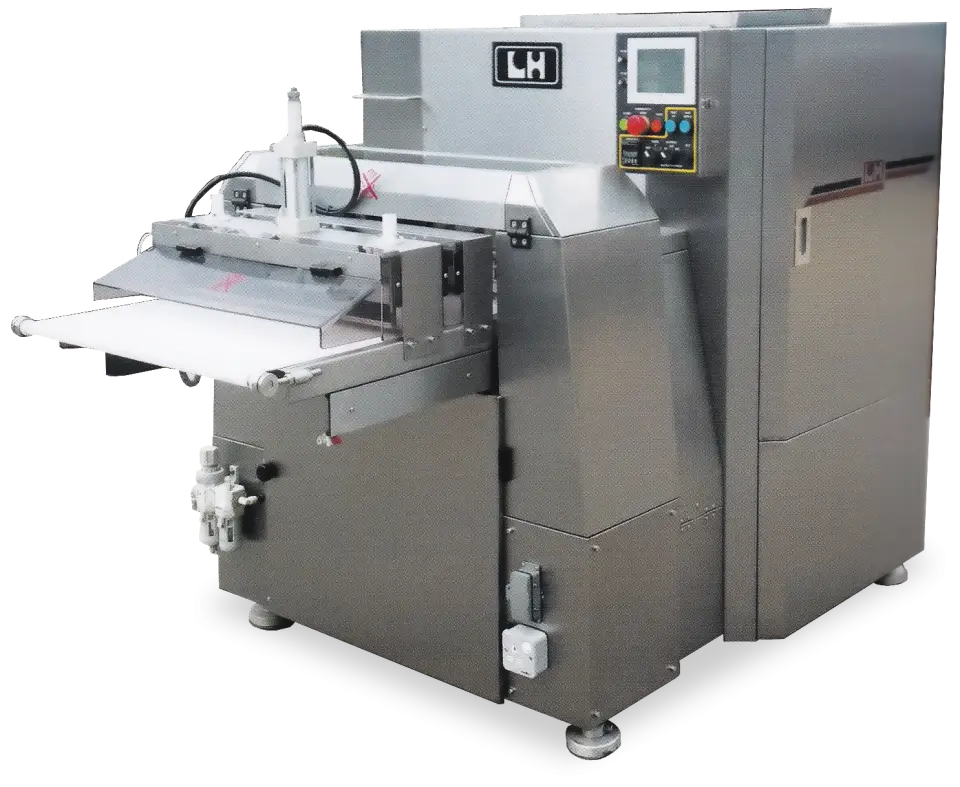
Dough Divider Rounder Make Up
Designed for commercial bakeries, central kitchens, and food manufacturers, the Lian Huat Dough Divider Rounder automates dough dividing and rounding to improve production efficiency and consistency. Available in multiple configurations and production capacities to suit different production requirements. It provides consistent dough portioning and uniform rounding for reliable downstream processing.
Built with industrial-grade construction and engineered for continuous production, the machine helps reduce dependence on manual labour while maintaining consistent dough handling and production output. Its automated dividing and rounding process supports more efficient bakery operations, improved product uniformity, and reliable performance in high-volume production environments.
Why Consistency at the Beginning Matters
Dough is not simply another raw material moving through a factory.
Its condition influences what happens later in the production process.
Variations in dough portion size can affect forming.
Differences in dough shape can affect handling.
Inconsistent production rhythm can make downstream equipment harder to synchronize.
When these variations are managed manually, workers are often required to continuously compensate for them.
This creates a cycle:
Variation → Manual Adjustment → Additional Labor → More Process Dependency
Automation can help break that cycle.
A Dough Divider Rounder can perform repetitive dividing and rounding operations according to controlled parameters, reducing the amount of manual intervention required to establish consistent dough portions and shape.
The value is therefore not simply that fewer workers are required at one station.
The larger benefit is that the process becomes more repeatable.
This provides a more stable input for the next stage.
And when the next stage is also automated, the benefit can continue downstream.
From Dividing and Rounding to Forming
Once the dough process becomes more consistent, the manufacturer can consider how to connect it with subsequent operations.
Depending on the product, this may include:
- forming;
- panning;
- proofing;
- baking;
- cooling;
- slicing; and
- packaging.
Not every manufacturer needs to automate all of these processes.
The appropriate sequence depends on production volume, product characteristics, layout, investment capacity, and future business plans.
The important principle is that each automation decision should consider what comes before and what comes after it.
A machine should not only perform its own task well.
It should provide a suitable output for the next process.
This is why production automation is better understood as a connected flow rather than a collection of individual machines.
Stable dough handling
↓
Consistent dividing and rounding
↓
Predictable forming
↓
Controlled product handling
↓
Downstream automation
↓
Integrated production line
The exact configuration will vary from factory to factory.
But the engineering principle remains:
Stabilize the process before trying to scale the process.
Full Automation Is Not Always the Best First Investment
The pressure to automate can sometimes lead manufacturers toward an all-at-once approach.
A complete production line appears attractive because it promises maximum automation from the beginning.
However, a complete line also requires the factory to change multiple things simultaneously:
- production layout;
- material flow;
- operating procedures;
- maintenance capability;
- workforce skills;
- quality control;
- production planning; and
- capital allocation.
If production volume is not yet sufficient, some equipment may remain underutilized.
If one process is not ready, it can become a bottleneck for the rest of the line.
If the factory changes its product mix later, an inflexible system can become difficult to adapt.
This is why the most appropriate automation strategy is not necessarily the one with the highest level of automation.
It is the one that matches the manufacturer's current production requirements and future direction.
The First Machine Should Not Become the Last Machine
This is one of the most important considerations when evaluating automation investment.
A manufacturer may initially purchase a Dough Divider Rounder because the current production process requires too much manual dough handling.
At that point, the machine solves today's problem.
But what happens three or five years later?
The business may have:
- increased production volume;
- added new products;
- gained larger customers;
- introduced additional shifts;
- expanded its factory;
- added new production lines; or
- moved toward centralized manufacturing.
The original machine should not become a limitation simply because the business has grown.
This leads to a different way of evaluating machinery investment.
Instead of asking only:
"What can this machine do today?"
manufacturers should also ask:
"How can this machine fit into the production system we may need tomorrow?"
That is the difference between buying equipment and planning a production system.
Automation Should Preserve Future Expansion Options
For a growing food manufacturer, the ideal first investment should solve a current production problem without closing off future possibilities.
This means considering not only how a machine will operate today, but also how it can support future production requirements as the business grows.
A Dough Divider Rounder may initially operate as a stand-alone machine.
At this stage, its role may simply be to reduce repetitive manual work, improve portion consistency, and establish a more stable production process.
However, the same Dough Divider Rounder can also serve as a starting point for a more integrated production line.
For example, a manufacturer may initially focus on producing burger buns. As demand grows or the product range expands, additional equipment can be introduced around the existing Dough Divider Rounder to create a more complete production process.
Depending on the product and production requirements, the Dough Divider Rounder can become part of different production line configurations, with additional processes such as intermediate proofing, topping or dusting, and automatic panning incorporated into the line.
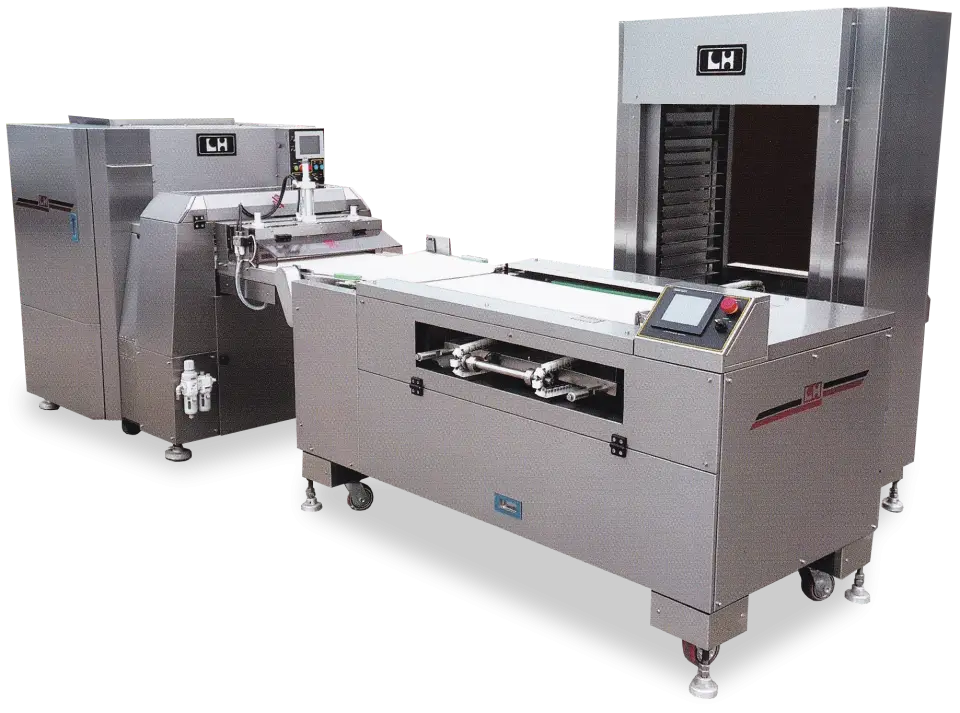
Dough Divider Rounder with Auto Panning System Make Up
Our advanced Automated Dough Processing Line seamlessly integrates a Dough Divider & Rounder with an Auto Panning Machine, streamlining your production process for consistent, high-quality baked goods.
This provides manufacturers with the flexibility to expand their production capabilities without necessarily replacing the equipment they have already invested in.
Future expansion may also take a different direction.
A manufacturer may decide to introduce new products such as bread rolls, requiring a different production setup. In this case, the existing Dough Divider Rounder can serve as part of the foundation, while additional machinery is added to create a production line suited to the new product.
Similarly, if the objective is to increase automation rather than introduce new products, equipment such as an Intermediate Proofer, Sesame Duster, or Automatic Panning System can be progressively added to reduce manual handling between production stages.
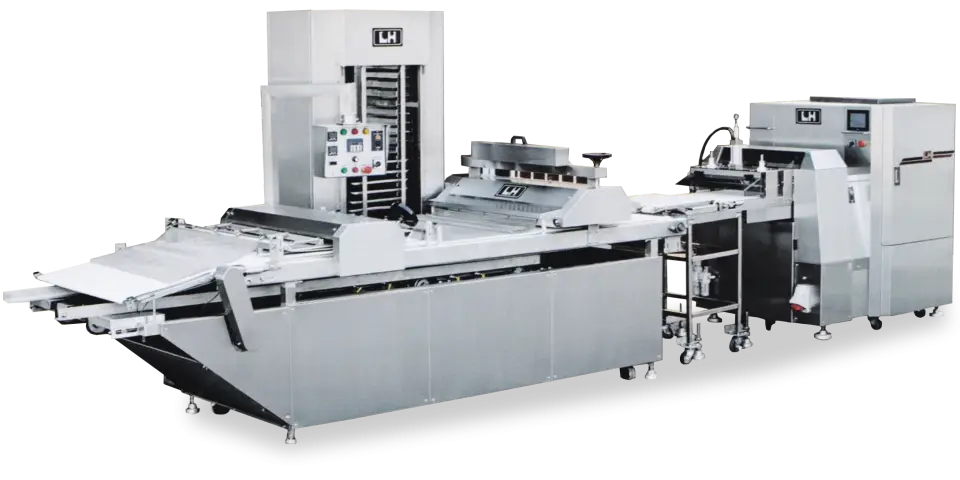
Burger & Bread Roll Line Make Up
Our innovative Comprehensive Automated Baking Line seamlessly integrates a Dough Divider & Rounder with Auto Tray Feeding and Auto Panning System, bringing unparalleled precision and automation.
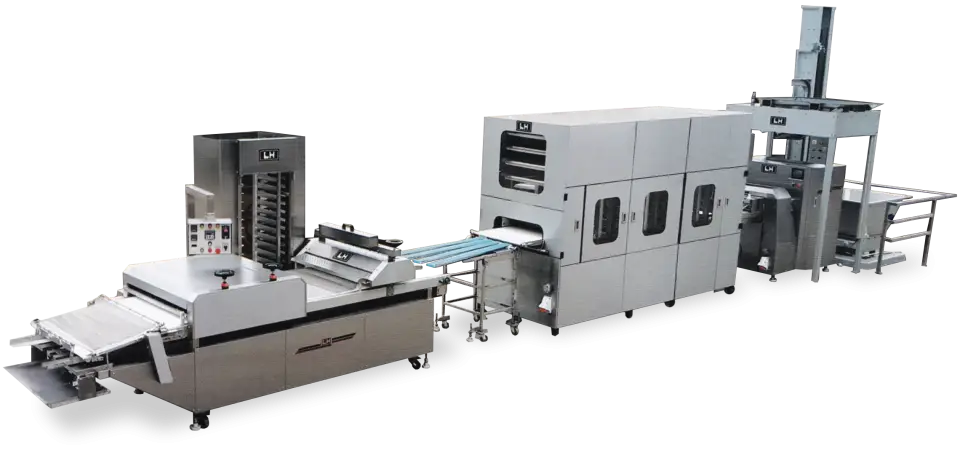
Complete Burger & Bread Roll Plant Line Make Up
The pinnacle of baking innovation – the Lian Huat Machinery’s Complete Burger & Bread Roll Plant Line. A comprehensive and highly innovative baking system that combine a range of advanced components that streamlines production.
In this way, automation can develop alongside the business:
Stage 1 — Stabilize
Reduce repetitive manual work and establish a more consistent process.
Stage 2 — Improve
Add equipment around the existing machine to reduce manual intervention between production stages.
Stage 3 — Expand
Use existing machinery as a foundation for new products, production processes, or higher production capacity.
Stage 4 — Integrate
Connect additional equipment to create a more continuous production flow with fewer manual transfer points.
Stage 5 — Scale
Expand the production system as demand grows, without having to redesign the entire setup from the beginning.
This approach provides an important financial advantage.
The manufacturer does not necessarily need to make the largest investment at the beginning.
Instead, the initial investment can become the foundation for subsequent investments — whether the goal is to develop a new product line, increase production capacity, or achieve a higher level of automation.
At Lian Huat, we look beyond the machine itself. We consider how today's equipment can become part of a larger production system as the manufacturer's business develops.
Today's machine can become the starting point for tomorrow's production line.
The Business Case for Automation Is Bigger Than Labor Saving
Labor reduction is easy to understand.
But it is only one part of the value equation.
A well-designed automation strategy can also influence:
Production consistency
Machines can perform repetitive processes according to controlled parameters rather than depending entirely on manual speed and physical endurance.
Quality consistency
More consistent processing conditions can reduce variation between batches and shifts.
Workforce flexibility
Production becomes less sensitive to changes in the number of workers available for repetitive tasks.
Physical workload
Workers can spend less time performing repetitive and physically demanding operations.
Production planning
A more predictable production rhythm makes it easier to plan output and downstream processes.
Scalability
Additional equipment can be introduced as production volume increases.
These benefits become increasingly important as manufacturers move from small-scale production toward larger and more structured operations.
The World Bank's findings are particularly relevant here: automation in several Southeast Asian economies has been associated with productivity and scale effects strong enough to offset some of the labor-displacement effects of robots.
In other words, the objective of automation is not necessarily to produce the same amount with fewer people.
It can also be to produce more reliably, then use that reliability to support business growth.
A Production Line Should Grow With the Business
This principle becomes particularly important for food manufacturers because demand is rarely static.
A company may begin with a limited number of products and moderate volumes.
As distribution expands, production requirements change.
New customers may demand higher consistency.
Retailers may require more reliable delivery.
Export markets may introduce stricter production and quality requirements.
The factory may then need to increase capacity.
If automation was planned only around today's requirements, expansion can become expensive and disruptive.
If automation was planned as a scalable system, expansion becomes a more manageable progression.
This is why machinery selection should consider not only current output, but also how equipment can fit into future production development.
The objective is not to predict exactly what the factory will look like five years from now.
It is to avoid making today's investment incompatible with tomorrow's requirements.
The Lian Huat Engineering Approach
At Lian Huat Machinery, we see automation as an engineering process rather than a simple equipment purchase.
Every manufacturer has different production requirements.
The right solution depends on the product, dough characteristics, production volume, layout, workforce, operating environment, and future expansion plans.
For this reason, the first step should not always be asking:
"Which machine should we buy?"
It should be:
"Which part of our production system should we stabilize first?"
For bakery manufacturers, dough handling, dividing, and rounding can be a logical starting point because they influence the consistency and rhythm of subsequent processes.
From there, automation can progressively extend toward forming and downstream processes.
Lian Huat's machinery portfolio includes Dough Divider Rounders as well as equipment and production solutions for subsequent stages of bakery production. This allows manufacturers to approach automation progressively rather than treating the factory as a single all-or-nothing investment.
The objective is not to force every manufacturer into the same production configuration.
It is to build a system that fits the manufacturer's current requirements while leaving room for future development..
Automation Is a Production Strategy, Not Just a Labor Solution
The labor question will continue to matter across Southeast Asia.
But the future of food manufacturing will not be determined simply by how many workers are available.
It will increasingly depend on how effectively manufacturers combine people, machinery, processes, and production planning.
Recent ASEAN discussions reflect the same direction. ASEAN labour ministers have identified rapid technological change, demographic shifts, evolving labour markets, and the need for industry-responsive skills development as major factors shaping the region's workforce.
The direction is clear:
Production is changing.
For food manufacturers, automation is one part of that transition.
But effective automation does not mean replacing people wherever possible.
It means identifying repetitive processes where human effort is being used primarily to maintain production volume, then redesigning those processes so that people can work alongside more consistent and scalable equipment.
The goal is therefore not:
People → Machines
It is:
Manual Process → Stabilized Process → Integrated Process → Scalable Production System
This is a much more sustainable way to approach automation.
Build for Stability Today. Prepare for Expansion Tomorrow.
For manufacturers considering their next automation investment, the most important question may not be how much labor a machine can save.
It may be whether the machine creates a better foundation for the next stage of the business.
A good automation investment should solve a real problem today.
A better one should also remain useful when production increases tomorrow.
That means reducing repetitive manual work, improving process consistency, creating a more predictable production rhythm, and allowing additional automation to be integrated when the business is ready.
The goal of automation is not to eliminate people.
It is to reduce production's dependence on repetitive manual labor.
And beyond that, the goal is to create a production system that can continue to develop as the business grows.
For Southeast Asian food manufacturers, that is the difference between simply buying a machine and building a production system.
Stability is the first step. Integration is the next. Scalability is the long-term objective.
References
-
[1]
ASEAN — ManufacturingAvailable at: investasean.asean.org
-
[2]
Asian Development Bank — Asian Development OutlookAvailable at: adb.org
-
[3]
OECD — Promoting Active Ageing in Southeast AsiaAvailable at: oecd.org
-
[4]
ASEAN — 29th ASEAN Labour Ministers MeetingAvailable at: asean.org
Recent Posts
See All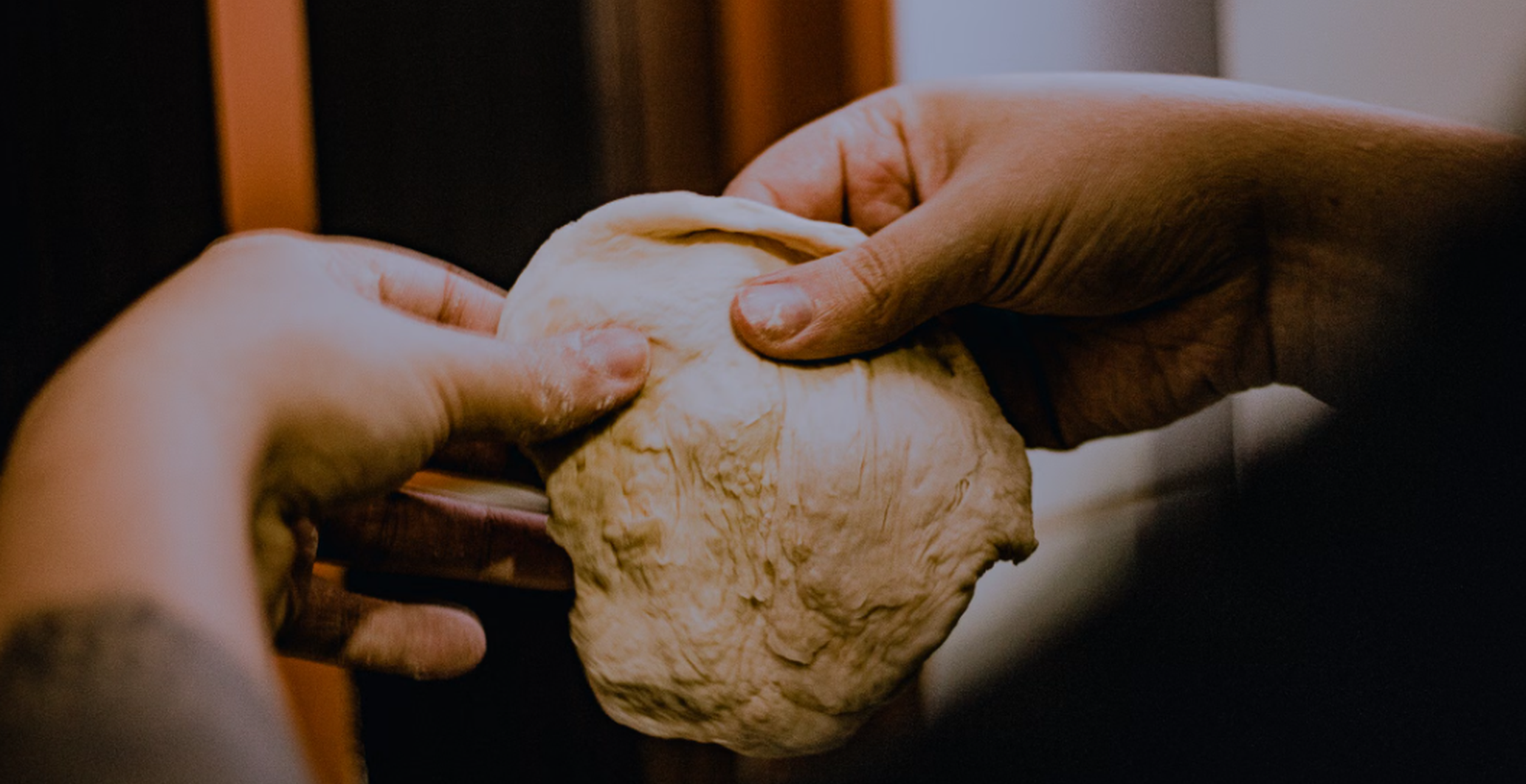
Henrick Low •
Oct 7, 2026 •
8 minutes read
Beyond Dough Hydration: How International Bakery Projects Shape Our Engineering Evaluation
How international bakery projects and servicing experience shape Lian Huat’s approach to evaluating dough characteristics and machinery requirements.
Read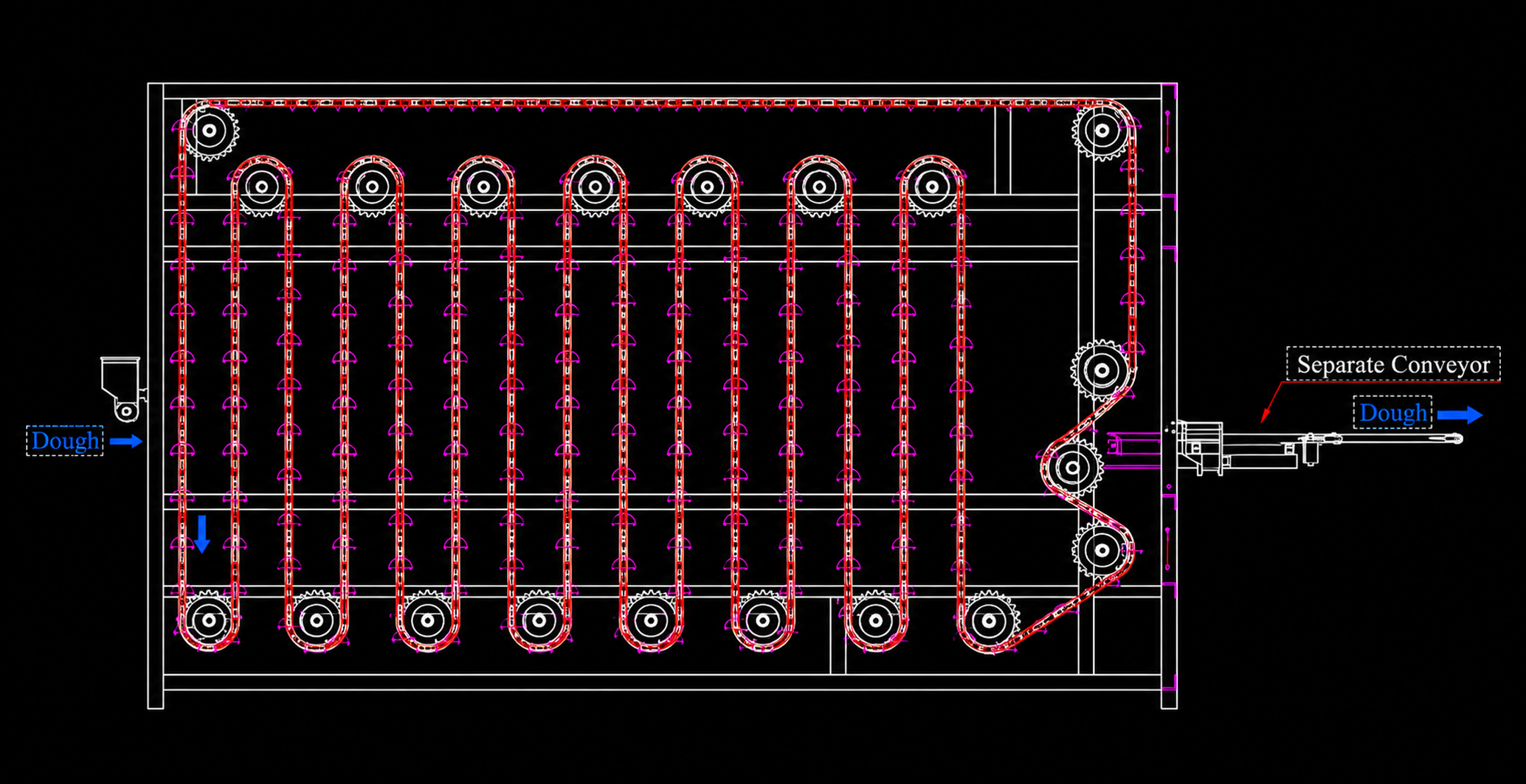
Henrick Low •
Sep 30, 2026 •
5 minutes read
Case Study: Designing a T-Shaped Intermediate Proofer for a Space-Constrained Bakery in Sri Lanka
A customized T-shaped intermediate proofer developed for a Sri Lankan bakery to automate proofing within limited installation space.
Read
Henrick Low •
Sep 29, 2026 •
5 minutes read
Case Study: Customizing Bakery Machinery for Easier Operation and Flexible Servicing in Taiwan
A Taiwan case study on customizing a machine's control system around the customer's operational and servicing requirements.
Read