
Case Study: Customizing Bakery Machinery for Easier Operation and Flexible Servicing in Taiwan
Case Study: Customizing Bakery Machinery for Easier Operation and Flexible Servicing in Taiwan
Customer Challenge
A bakery manufacturer in Taiwan was facing a practical workforce challenge.
The customer was experiencing difficulties in hiring and retaining technicians and skilled machine operators. Staff turnover also meant that production personnel could change regularly, creating a need for machinery that remained straightforward to operate and practical to maintain.
At the same time, the customer wanted greater flexibility in arranging machine servicing. Rather than relying solely on in-house technicians, they wanted the option to engage an external servicing team when required.
As a result, the customer was looking for a machine configuration that would be suitable for their production environment while keeping daily operation and servicing straightforward.
Understanding the Customer's Requirements
For this project, Lian Huat looked beyond the machine's standard specifications and considered how the equipment would be operated and serviced in the customer's actual working environment.
The key considerations included:
Straightforward daily operation
Ease of understanding for different operators
Practical servicing arrangements
Flexibility to engage external service personnel
A control system suited to the customer's local operating environment
Based on these requirements, Lian Huat reviewed the machine's standard control configuration and considered an alternative approach.
From Standard PLC Control to a Customized Analog Control Panel
Lian Huat's standard machine configuration uses a PLC-based control panel. For this particular customer, however, the control arrangement was customized according to their operational and servicing requirements.
Lian Huat developed an analog control panel specifically for this project.
The purpose was not to replace the standard control system with a more or less sophisticated solution. Instead, the control panel was configured to provide a straightforward operating arrangement that better matched the customer's workforce and servicing requirements.
Standard PLC Control Panel
.jpeg)
Lian Huat's standard control configuration.
Customized Analog Control Panel
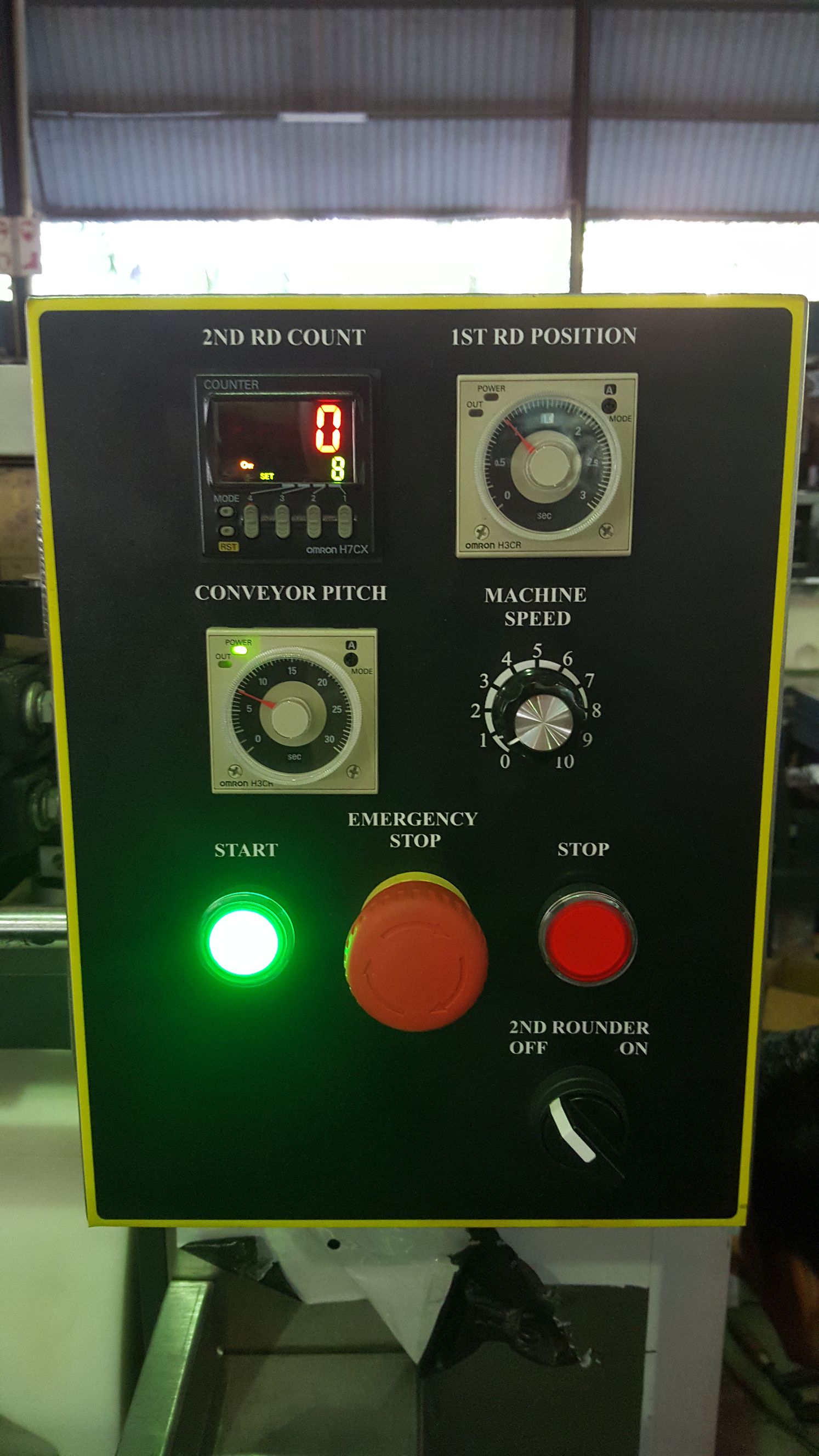
Control panel developed according to the customer's operating and servicing requirements.
The comparison demonstrates how the same machine can be configured differently depending on the customer's production environment and operational requirements.
Engineering Considerations
The customization involved more than simply changing the appearance of the control panel.
Lian Huat considered how the machine would be used on a daily basis and how servicing would be managed when technicians were not available in-house.
The control arrangement was therefore designed with several practical considerations in mind:
Operators should be able to understand the main machine functions clearly.
The control interface should be straightforward for daily production use.
External service personnel should be able to work with the machine as part of the customer's servicing arrangement.
The overall configuration should remain practical for long-term operation despite changes in production personnel.
This approach allowed the control system to be adapted to the customer's actual working conditions rather than applying the standard configuration without modification.
Designed Around the Customer's Operating Environment
This project demonstrates an important part of Lian Huat's approach to customized bakery machinery.
Machine customization is not limited to production capacity, dough weight range, machine dimensions or additional equipment. Depending on the application, the control system and operating interface can also be adapted to suit the customer's production environment.
In this case, the customer's workforce and servicing arrangements were important factors in determining the appropriate control configuration.
Rather than requiring the customer to adapt their operation to a fixed machine configuration, Lian Huat adapted the machine to better suit the way the customer operates.
Supporting Flexible Servicing
The customer also wanted the flexibility to engage an external servicing team when required.
The customized analog control panel provides a straightforward control arrangement that can be understood and serviced by personnel familiar with conventional industrial electrical systems.
This gives the customer greater flexibility when arranging maintenance and servicing, particularly when their own workforce changes over time.
For customers operating in locations where hiring and retaining technicians can be challenging, the ability to consider servicing requirements during the machine design stage can be an important part of the overall equipment solution.
Beyond Standard Machine Configurations
This Taiwan project illustrates how engineering customization can address challenges that are not visible in a conventional machine specification.
Production capacity and machine performance remain important, but the suitability of industrial equipment also depends on how it fits into the customer's workforce, production process and maintenance arrangements.
By understanding these factors before finalizing the machine configuration, Lian Huat was able to develop a control solution specifically for this customer's operating environment.
Key Takeaway
A customized machine does not always mean adding more functions or increasing automation.
Sometimes, the most practical solution is to configure the machine around the way the customer operates, including how the machine will be used, maintained and serviced.
For this Taiwan customer, Lian Huat adapted its standard machine configuration and developed a customized analog control panel to provide a straightforward operating and servicing arrangement.
This case demonstrates Lian Huat's approach to bakery machinery engineering:
Understand the customer's operating environment, identify the practical requirements, and adapt the machine accordingly.
Recent Posts
See All
Henrick Low •
Oct 7, 2026 •
8 minutes read
Beyond Dough Hydration: How International Bakery Projects Shape Our Engineering Evaluation
How international bakery projects and servicing experience shape Lian Huat’s approach to evaluating dough characteristics and machinery requirements.
Read
Henrick Low •
Sep 30, 2026 •
5 minutes read
Case Study: Designing a T-Shaped Intermediate Proofer for a Space-Constrained Bakery in Sri Lanka
A customized T-shaped intermediate proofer developed for a Sri Lankan bakery to automate proofing within limited installation space.
Read
Henrick Low •
Sep 15, 2026 •
7 minutes read
Artisan or Industrial? Why Bakery Automation Does Not Have to Mean Choosing One Over the Other
Artisan and industrial baking are not opposites. Discover how bakery automation can improve consistency, efficiency, and scalability while preserving the product identity that makes a bakery unique.
Read